








 CoinDesk
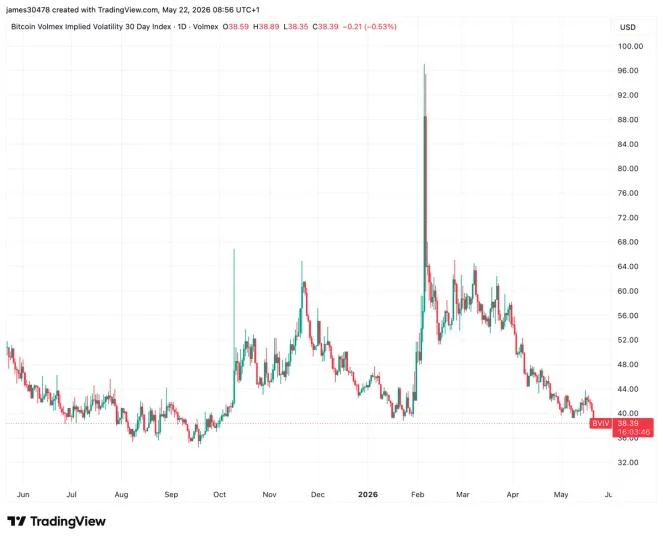



Bitcoin's annualized 30-day implied volatility index, BVIV, has slid to 38% — its lowest reading since October 2025, per Volmex data — even as macro headlines continue to flash warnings. The calm reflects a convergence of forces: easing geopolitical tensions, relentless institutional buying, and systematic options selling by yield-enhancement funds.
Shiliang Tang, Managing Partner at Monarq Asset Management, pointed to three drivers: the Iran conflict moving into its later stages, Strategy's (MSTR) continuous BTC accumulation acting as a structural price floor, and aggressive call overwriting by institutional funds suppressing the entire volatility complex. Strategy has purchased 171,238 BTC in 2026 alone — nearly three times the roughly 63,450 BTC mined over the same period — reinforcing a persistent supply squeeze.
The deeper read is structural maturity. As BTC adoption spreads…

Frequently asked questions
-
What factors contributed to the decline in Bitcoin's implied volatility?
The decline in Bitcoin's implied volatility is attributed to easing geopolitical tensions, institutional buying, and systematic options selling by yield-enhancement funds.
-
How does Strategy's BTC accumulation impact Bitcoin's price stability?
Strategy's continuous accumulation of BTC is acting as a structural price floor, which helps stabilize prices amid market fluctuations.
 WuBlockchain
 Crypto News
 Altcoin Daily
 WatcherGuru
 CryptoSlate
 TheBlock